
Our recommendation
Treat drainage, air entrainment, curing and winter care as one durability plan.
For exterior concrete in the Hudson Valley, our recommendation is to make water management and cold-weather exposure explicit in the written scope. The mixture and protection plan should match the conditions at placement, while the finished grading should move water away from the slab and nearby structures.
No sealer or deicer rule can compensate for a vague installation plan. Ask who confirms the exterior mixture, how fresh concrete will be cured and protected, where meltwater will travel, and which winter products are approved for the finished surface.
Water management comes first
Freeze–thaw cycles make uncontrolled water especially important to address. Surface slope, downspouts, adjacent grades and where water can safely travel should be part of the layout discussion.
The unseen work supports the visible work
Excavation and compacted base preparation create the foundation for the finished slab or paver system. Ask the contractor to describe this work in the proposal.
Joints and maintenance are part of the system
Joint layout, curing practices, sealers and winter maintenance all affect performance. Get written care instructions that match the finish you selected.
Plan for four-season use
Think about the patio in January as well as July.
The patio may host most gatherings in warm weather, but winter snow, ice and meltwater are part of its life too. Where snow will be piled, how downspouts discharge and which route must remain walkable all belong in the design conversation.
A practical care plan should match the selected finish. Decorative surfaces, driveways and simple broom-finished patios may not all receive the same maintenance advice.
Keep water destinations visible
Follow where roof water, melting snow and yard drainage currently travel. The new surface should be planned within that larger picture so water is not simply moved from one problem area to another.
See what is reviewed on siteAsk for finish-specific care guidance
Before winter, know what cleaning, deicing and sealing guidance applies to the project. Written instructions are more useful than assumptions carried over from a different surface or product.
Explore a practical finish optionTurn winter risk into written decisions
The proposal and handoff should explain how the slab is protected before and after opening day.
NRMCA defines cold-weather concreting by sustained low temperatures, not by a single chilly morning. Under those conditions, placement temperature, set time, protection and curing require specific planning. Homeowners should not be expected to invent that plan after the concrete arrives.
After handoff, keep the exact care instructions for the selected finish and sealer. Avoid assuming that a product acceptable on asphalt, stone or older concrete is appropriate for new decorative concrete.
Map every water source
Trace roof runoff, downspouts, sump discharge, irrigation, pool splash and the lowest lawn areas. Ask where water will travel when the ground is frozen or snow blocks the normal route. The goal is a property-level drainage conversation, not a promise based on one slope number.
See the on-site planning processUse a finish-specific winter handoff
Request written timing for first use, cleaning and sealing, plus approved snow-removal and deicing practices. Plastic shovels, prompt snow removal and keeping metal edges from gouging the surface may be sensible, but the contractor and product instructions should control the final care plan.
Plan winter-exposed concreteDocumented Hudson Valley example
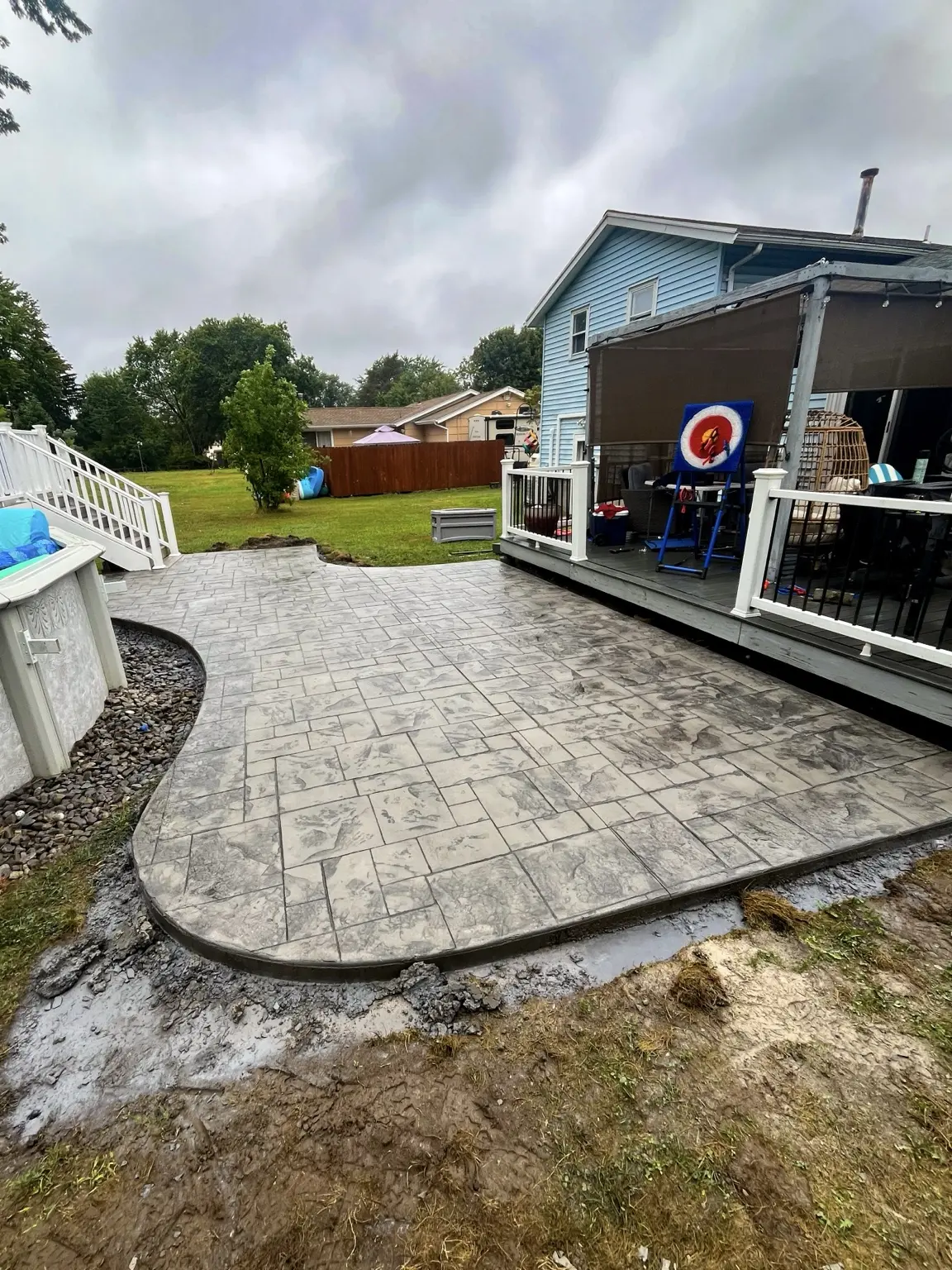
The Poughkeepsie patio puts winter planning in a real backyard context
The documented patio sits between a deck, pool area and open lawn. That layout creates several water sources and snow-storage decisions: roof runoff near the deck, meltwater across the curved edge and a route that may need to remain walkable outside pool season.
The photograph is useful because it shows why generic slope advice is incomplete. Drainage has to be considered across the whole property, including the house, existing structures and safe discharge point—not just across one isolated slab.
Technical references
Sources behind this guide
These references support the construction and climate principles in this article. Your property, product instructions and written project scope still control the final recommendation.
- NRMCA CIP 27: Cold Weather Concreting — placement, protection and strength-development guidance for cold conditions
- NRMCA CIP 11: Curing In-Place Concrete — explains why moisture and temperature control affect strength and durability
- NWS Albany climate data for Poughkeepsie — official local frost, freeze and climate-normal resources
- American Cement Association: air-entraining cement — describes air entrainment as a freeze–thaw durability strategy
The final recommendation should come from the actual property, written scope and contractor—not a generic article.