
Our recommendation
Pick concrete for a continuous, lower-joint surface; pick pavers for modular repairability and masonry detail.
We favor concrete for broad curves, coordinated patios and walks, and homeowners who want fewer surface joints to manage. We favor interlocking pavers when individual-unit access, strong pattern definition or a masonry vocabulary matters more than routine joint maintenance.
The decisive factor is not the product alone. Both systems depend on excavation, drainage and a well-defined base, and both can disappoint when the proposal spends more words on color than on preparation and edge conditions.
Both systems depend on preparation
Concrete and pavers are different finished systems, but neither succeeds on a poorly prepared base. Excavation, drainage and compaction should be clear in either proposal.
Where concrete stands out
Concrete creates a continuous surface with options ranging from restrained broom finishes to decorative stamping. It can be efficient for broad, clean shapes and coordinated walks or steps.
Where pavers stand out
Pavers offer modular patterns, strong border definition and the ability to access individual areas later. Joint maintenance and potential movement should be part of the long-term conversation.
Use the same comparison checklist
Ask both bidders to define access, demolition, base, drainage, edge treatment, finish, cleanup, warranty and maintenance. Then compare systems on an equal scope.
Compare the finished feeling
Decide whether you prefer a continuous canvas or a modular outdoor floor.
Concrete can create broad, clean shapes with finishes ranging from understated to decorative. Pavers bring repeating units, blended color and strong border definition. Both can support the same dinners and gatherings, but they create a different visual rhythm.
Look at complete patios beside homes similar in style to yours. Close-up samples cannot show how a material reads across the full yard.
Consider how the surface will age
Concrete and paver systems have different maintenance conversations. Ask about joints, sealers, individual-unit access, movement and repair expectations so the ownership experience is as clear as the installation price.
Review complete project layoutsKeep the layout decision separate
A well-sized footprint adds more daily value than an expensive material squeezed into too little space. Establish dining, seating and circulation needs before allowing the surface choice to consume the budget.
Plan the footprint firstCompare complete systems
Make both proposals answer the same base, edge, drainage and maintenance questions.
For concrete, ask about the slab design, joints, curing and finish. For pavers, ask about excavation, aggregate base, bedding layer, edge restraint, joint material and how cut units will be handled. Vague phrases such as “standard base” do not make systems comparable.
Then discuss the likely repair path. Concrete repairs may remain visually apparent; pavers can be lifted and reset, but matching aged units and restoring the base still require skill.
Do not confuse modular with maintenance-free
Pavers offer access to individual areas, but joints and perimeter restraint remain active parts of the system. Ask what joint replenishment, weed management or settlement correction may be expected and whether extra matching units will be left for future work.
Explore paver patio planningDo not confuse continuous with crack-proof
Concrete uses planned joints to manage where shrinkage movement is encouraged to occur, but no responsible contractor should promise a crack-free slab. The useful questions concern joint layout, drainage, base, curing and how the finish will make normal changes more or less visible.
Explore concrete patio planningDocumented Hudson Valley example
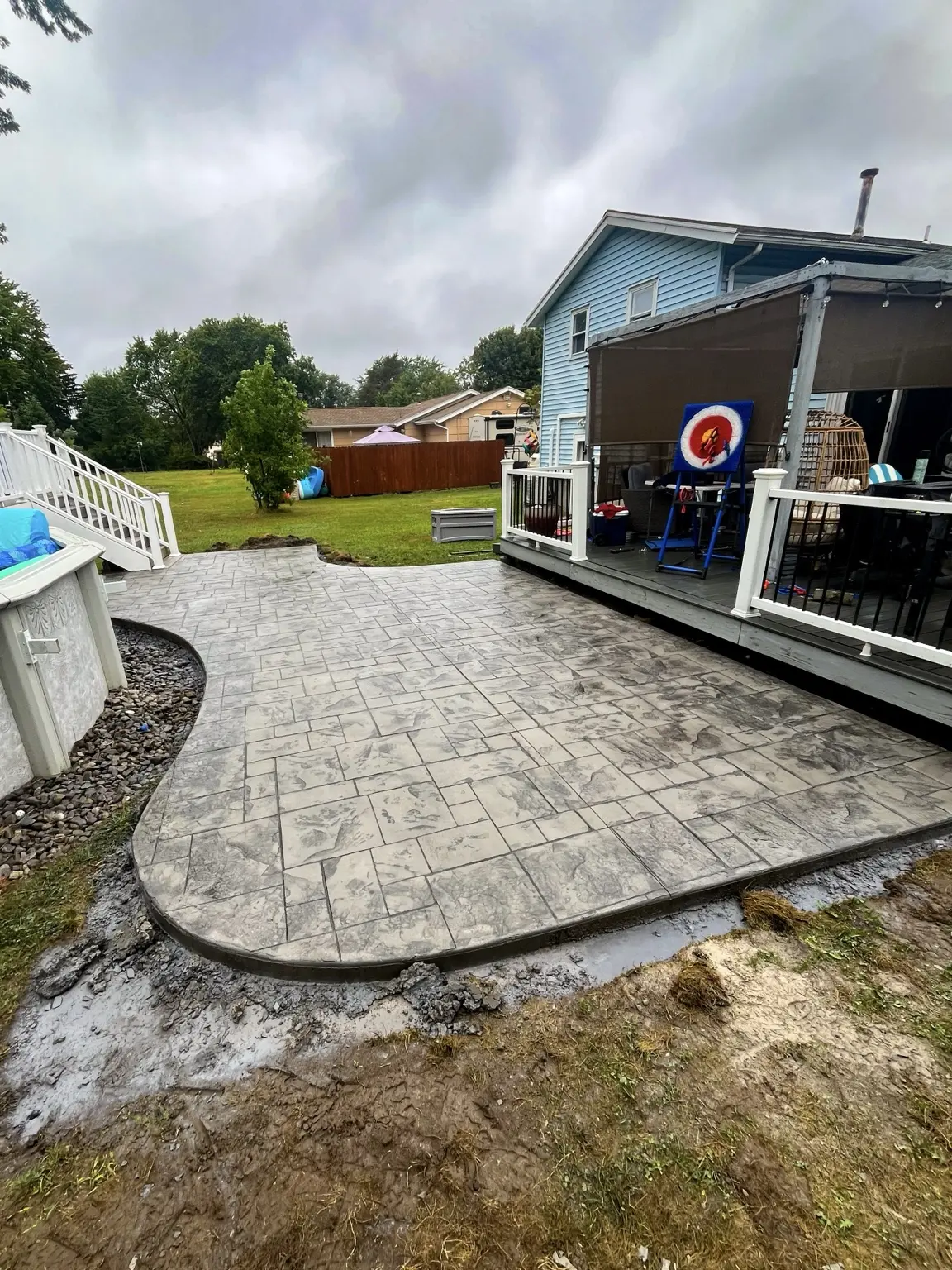
A concrete example with the visual depth many homeowners seek from pavers
The Poughkeepsie project shows how stamped concrete can create a stone-inspired surface while remaining one continuous custom-shaped placement. The curved edge ties together an existing deck, pool and lawn without requiring a separate unit pattern at every transition.
It does not prove concrete is universally better. It shows why the comparison should begin with the desired layout and visual rhythm. A paver proposal for the same yard would need equally clear base, edge-restraint, cut and joint specifications to be meaningfully compared.
Technical references
Sources behind this guide
These references support the construction and climate principles in this article. Your property, product instructions and written project scope still control the final recommendation.
- CMHA interlocking pavement construction guide — specification guidance for base, bedding sand, cutting and edge restraints
- CMHA paver operation and maintenance guide — documents joint, settlement, edge-restraint and repair considerations
- ACI Guide to Residential Concrete Construction — residential concrete guidance for subgrade, slabs, jointing and curing
The final recommendation should come from the actual property, written scope and contractor—not a generic article.